
Biphasic peels: technological evolution and clinical results
Biphasic peels: technological evolution and clinical results
Chemical peeling is a well-established procedure in dermatological practice, used to induce exfoliation at the epidermal and/or dermal level for regenerative purposes. The biological principle is the removal of the superficial skin layers, followed by a cascade of reparative events involving keratinocyte proliferation, extracellular matrix remodeling, and new collagen synthesis.
Despite their proven efficacy, traditional peels exhibit significant variability in depth of action and clinical response. This variability has encouraged the development of more advanced systems, including two-phase peels, designed to improve control of active ingredient diffusion.
From traditional peeling to two-phase systems

Conventional peels rely on aqueous solutions of organic acids that induce exfoliation by disrupting corneocyte junctions and denaturing proteins. However, their action can be unpredictable due to uncontrolled diffusion.
The main critical points of traditional peels include:
- non-selective diffusion of active ingredients into the skin layers
- high dependence on pH and concentration
- risk of inflammatory reactions and post-inflammatory discoloration
- interindividual variability of clinical response
Biphasic systems introduce a more sophisticated structure , consisting of a lipophilic phase (facilitates penetration through the hydrolipidic film and improves the bioavailability of the active ingredients) and a hydrophilic phase (carries acids and functional molecules with exfoliating and regenerating action). This organization allows for more controlled penetration and better distribution of the active ingredients .
In functional terms, the benefits are:
- gradual and sequential release of active ingredients
- greater uniformity of skin diffusion
- reduction of irritation peaks
- better exfoliation control
From a biological point of view, this translates into a more modulated inflammatory response and a more efficient regenerative process.
Treatment personalization
The introduction of biphasic peels has strengthened the paradigm of personalized medicine. Treatment is no longer standardized, but adapted to the specific characteristics of each patient.
The clinical evaluation must consider:
- phototype
- skin barrier integrity
- presence of active inflammation
- predisposition to post-inflammatory hyperpigmentation
Thanks to biphasic technology, the doctor can precisely modulate the therapeutic protocol by intervening on:
- contact time
- number of steps and stratifications
- combination with other procedures (fillers, biostimulation)
This approach allows to improve the predictability of results and reduce the risk of side effects, while maintaining highclinical efficacy.
Supernova Technology: Nebula | ACTO² and Nebula | ACTO² ORION
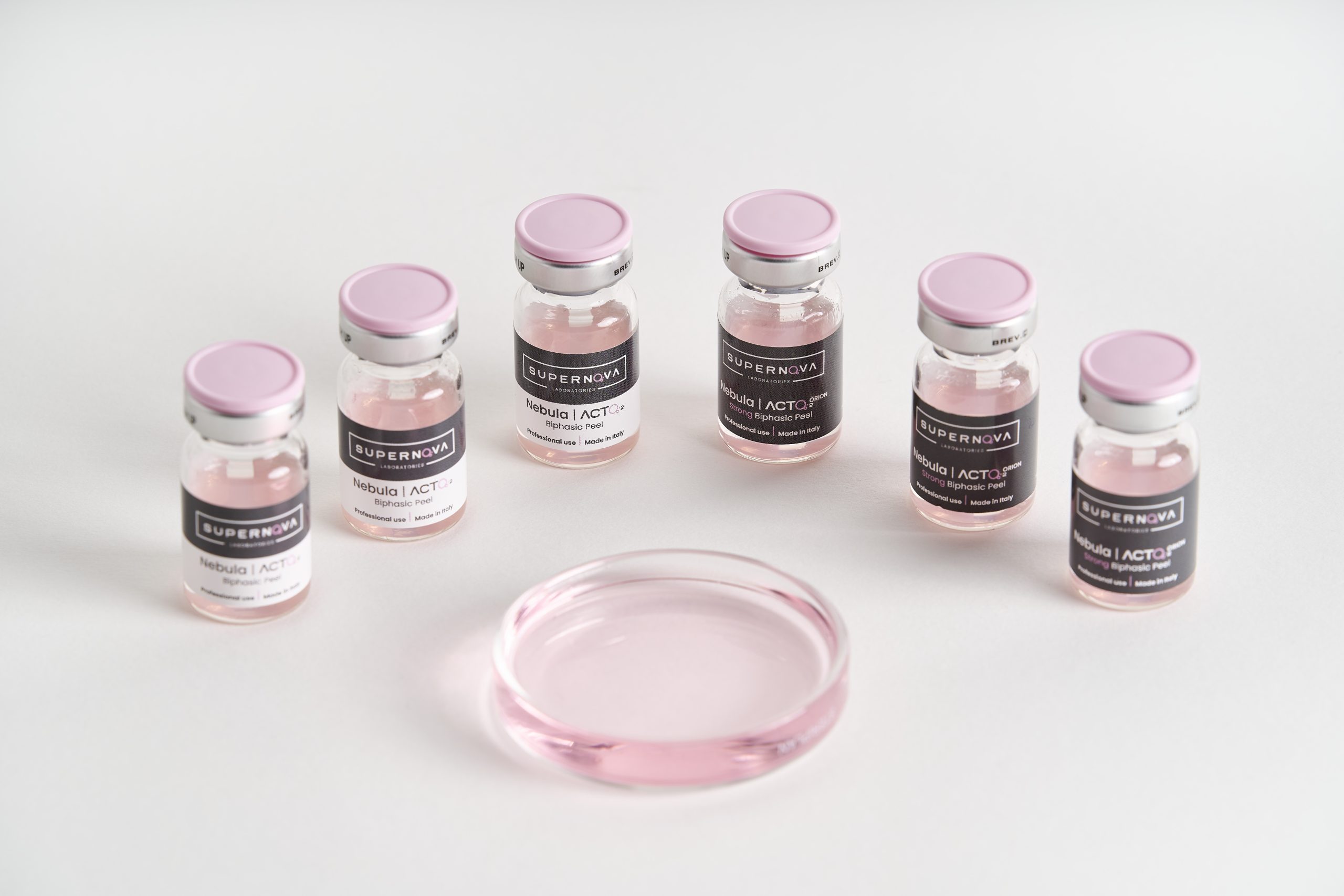
In the context of advanced biphasic peels, the Supernova line developed by Ksurgery MED represents an advanced application of the concept of controlled product release.
Nebula | ACTO²
Nebula | ACTO² is primarily indicated for the treatment of acne-prone and seborrheic skin. Its biological rationale is based on a combined action that targets multiple physiopathological levels of acne.
In particular, the treatment allows:
- normalization of follicular keratinization
- reduction of sebum production
- control of the inflammatory component
- improved microbial colonization
- Exfoliation of the outer layers of the skin and stimulation of cell turnover
- Improved skin texture and tone by reducing fine lines, acne scars, hyperpigmentation and sun damage, making skin smoother and more even-looking
From a clinical point of view, a progressive reduction of acne lesions and an improvement in skin texture are observed , with limited downtime and good tolerability even in the most sensitive patients.
Nebula | ACTO² ORION
Nebula | ACTO ² ORION represents an evolution of the protocol, designed for more complex and multifactorial skin conditions
Its main indications include:
- persistent acne with a deep inflammatory component
- superficial scarring
- post-inflammatory hyperpigmentation
- early signs of photoaging
The added value of this formulation lies in its ability to combine:
- a controlled exfoliation
- a deeper regenerative stimulation
- an overall improvement in skin quality
The synergistic effect of the two phases allows for simultaneous intervention on different layers, making the treatment particularly versatile and effective.
Clinical indications and seasonality
Biphasic peels find application in a wide spectrum of dermatological conditions, thanks to their versatility and modulability.
The main indications include:
- mild to moderate acne
- discolorations (melasma, sunspots)
- photoaging
- irregularities in skin texture
A particularly important factor is the seasonal nature of the treatment. Compared to traditional peels, two-phase systems offer greater flexibility thanks to an improved safety profile.
Seasonality benefits include:
- lower risk of photosensitization
- can also be used during periods of moderate sun exposure
- reduction of pigmentary complications
However, theadoption of rigorous photoprotection to guarantee patient safety and the stability of the results.
Conclusions
Biphasic peels represent atechnological evolution compared to traditional peels, thanks to their ability to modulate the penetration of active ingredients and optimize the skin's biological response.
The main advantages are:
- greater control over skin reactions
- better tolerability
- reduction of side effects
- highly personalized treatment
Within this scenario, the Supernova protocols, in particular Nebula | ACTO² and Nebula | ACTO² ORION, constitute a concrete example of innovation applied to clinical practice, offering effective and versatile tools for the management of the main dermatological conditions in the aesthetic field.
Bibliography
- Rubin MG. Chemical Peels: Procedures in Cosmetic Dermatology. Elsevier, 2019.
- Fabbrocini G, De Vita V, Pastore F, et al. “Chemical Peels: What's New and What Isn't New but Still Works Well.” Facial Plastic Surgery, 2009.
- Monheit GD, Yu RJ. “Chemical Peels.” Dermatologic Clinics, 2000.
- Dayan SH, et al. “Efficacy and Safety of Superficial Chemical Peels.” Journal of Clinical and Aesthetic Dermatology, 2019.
- Draelos ZD. Cosmetic Dermatology: Products and Procedures. Wiley-Blackwell, 2015.
- Technical documentation and internal clinical materials, Ksurgery MED – Supernova line.